
Health is something we all share. My own, my family's, and the care any of us can count on as a community when someone needs it, whether that's someone we love or someone we'll never meet. It sits in the background until the day it's the only thing that matters.
So when I look at where AI is going, healthcare is where I feel most hopeful. AI brings plenty of challenges, and I'm not naive about them. Even so, faster diagnoses, earlier warnings, shorter hospital stays, and doctors with more time for patients and less for paperwork aren't hype. Some of it is already happening, and in the right cases it could save lives.
That's why a CBC News story this week stuck with me.
The part that makes me uneasy
Here's the thing about AI. It runs on data. In healthcare, that data is us. Our diagnoses, our prescriptions, our visits, our family histories. For AI to do the good I just described, it needs a lot of that information, and it needs it to flow.
The CBC story reports on a commentary in the Canadian Medical Association Journal by Dr. Sheryl Spithoff of Women's College Hospital and Teresa Scassa, Canada Research Chair in Information Law and Policy at the University of Ottawa, who argue that Canada's proposed privacy law, Bill C-36, leaves real gaps for health data.
I'm not a privacy lawyer, so here's how I read their concerns in plain terms.
- Companies could decide for themselves. The bill would let a private company collect, use and even disclose your personal information without your consent if it decides its "legitimate interest" outweighs the harm to you. There are conditions, like a privacy impact assessment, and the company is still the one grading its own homework.
- "Anonymous" may not stay anonymous. Data a company judges to be anonymized would fall outside the law entirely. With so much other data out there, and AI this good at connecting dots, the experts question whether anything can truly be anonymized anymore.
- You can be hurt without being named. Even data with no names attached can shape decisions about people like you, from insurance to which patients get extra care. Biased data builds biased AI.
None of the people quoted are saying stop. One of them, Dr. Amol Verma at St. Michael's Hospital, uses de-identified hospital data with AI to help people spend less time in hospital, safely. His view is that innovation and privacy have to move together. I agree with him completely.
Why I'm still encouraged
I'll own my bias here. I work at DataStealth, where we build a Data Security Platform, and protecting sensitive data is what we do every day.
That's also exactly why I can say this with confidence. The question isn't whether we can put real guardrails around health data. We can. The tools exist today to protect identifying information where it lives, so the people and AI systems using the data only see what they actually need.
This is where the word "anonymized" deserves a closer look. Anonymizing data means altering it until, supposedly, no one can be traced, and then letting it go. Once an organization decides its data meets that bar, the data falls outside the law, and everyone is left hoping nobody ever connects the dots.
Protecting data is a different idea. With tokenization, for example, names, health card numbers and other identifiers are swapped for placeholder values, and the real ones stay locked away in a separate vault, where the organization decides who can ever see them. When the same patient always gets the same placeholder, researchers and AI systems can still link that patient's visits, find the patterns and learn from them, without holding names or health card numbers.
The organization never hands off responsibility. It decides who can see what, and keeps a record whenever real values are revealed.
That's not magic, and it isn't the same as anonymous. Under Bill C-36, data protected this way stays personal information and stays inside the law, which is exactly the point, because the organization remains accountable for it. Details like postal codes, dates and rare diagnoses can still point to someone if they're left exposed, so each needs its own treatment.
Some get coarsened, some shifted, some held back, depending on what the analysis really needs. Swapping out the direct identifiers is the first step, not the last. Done properly, the data can keep doing good while it stays protected, instead of being declared safe and set loose.
What worries me more than the law is the temptation to wait for it.
Bill C-36 will be debated, amended and argued over, and it should be. In the meantime, no healthcare organization should treat a legal label, or anyone else's assurance, as the thing protecting its patients.
Calling data "anonymized" doesn't make it safe. Deciding to protect it does.
That decision belongs to the organizations that hold our data. For health tech companies, insurers and anyone licensing health data, Bill C-36 is the law that applies. Hospitals, clinics and labs answer to provincial health privacy laws, and the same choice is in front of them. They can choose to say, "We're going to protect this ourselves, at the source, and be able to show how."
That's what earns trust. And trust is what keeps patients willing to share the data that makes AI in healthcare work in the first place.
Technology won't solve everything here. It won't remove bias from a training set, and it won't decide whether a given use of data is the right one.
Those are human judgments. What it can do is make sure far less identifiable information moves around, far fewer people see it, and there's a record of who did.
Think in weeks, not years
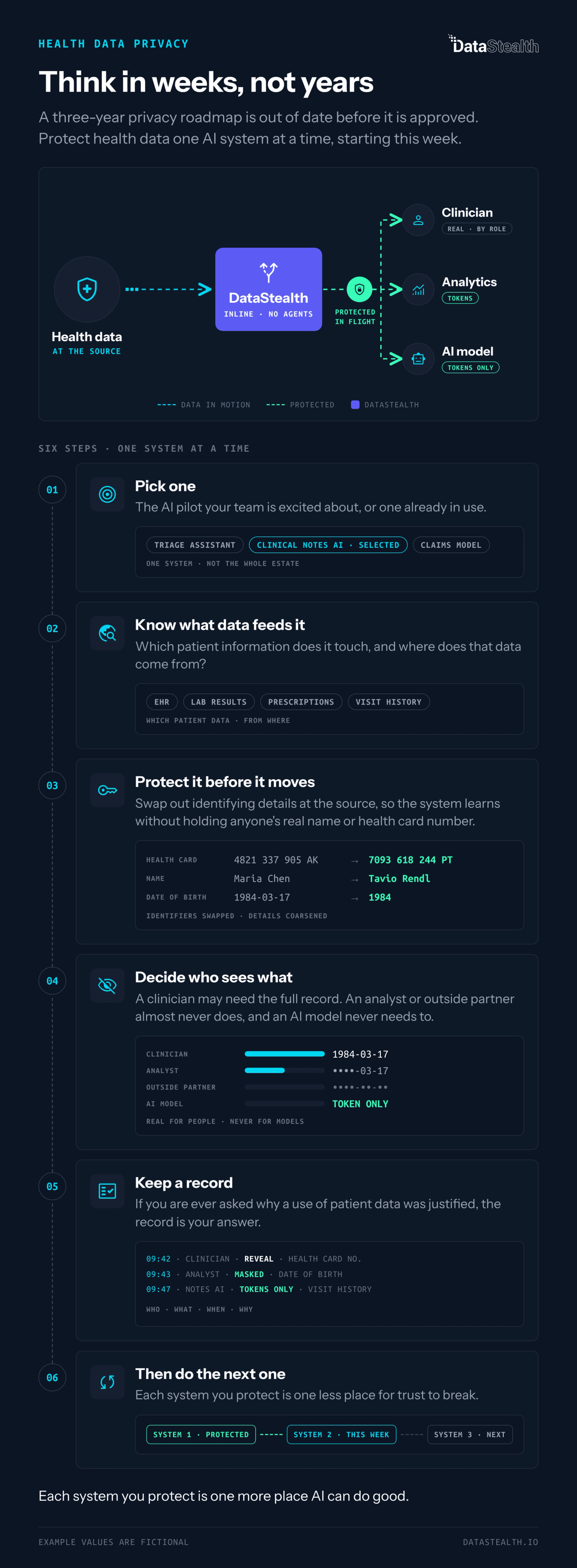
So what does moving fast and earning trust actually look like? In my experience, it doesn't look like a privacy roadmap that runs three years. By the time a plan like that is approved, the AI landscape it was written for is gone.
We're not moving in years anymore. We're moving in weeks.
It also doesn't look like trying to solve everything at once. It looks like taking it one AI system at a time.
- Pick one. The AI pilot your team is excited about, or one that's already in use.
- Know what data feeds it. Which patient information does it touch, and where does that data come from?
- Protect it before it moves. Swap out identifying details at the source, so the system gets what it needs to learn without holding anyone's real health card number or name.
- Decide who sees what. A clinician may need the full record. An analyst or outside partner almost never does, and an AI model never needs to. Real for people, never for models.
- Keep a record. If you're ever asked to show why a use of patient data was justified, the record is your answer.
- Then do the next one.
Lay out what that journey looks like for your organization, and start this week. Each system you protect is one less place for trust to break, and one more place AI can do good.
We don't have to choose
I don't believe we have to pick between AI that makes healthcare better and data that stays protected. That's a false choice, and accepting it would cost us either way. Either we hold back tools that could help people, or we lose the trust that makes those tools possible.
We can move fast and earn trust at the same time. It just takes organizations deciding to own it, one system at a time, starting now.
Whoever is in that hospital bed, someone I love or someone I'll never meet, that's the care I want for them. I suspect you do too.
If you're working through how to protect patient data as you bring AI into your organization, I'd love to hear where you're starting. Get in touch with our team.

As Chief Product Officer, Mark Cassetta leads product strategy for the DataStealth Data Security Platform. A product leader with more than 15 years in enterprise security, including CPO roles at eSHARE and Axiomatics, he focuses on helping organizations use sensitive data with AI while keeping it protected.
Connect on LinkedIn →