

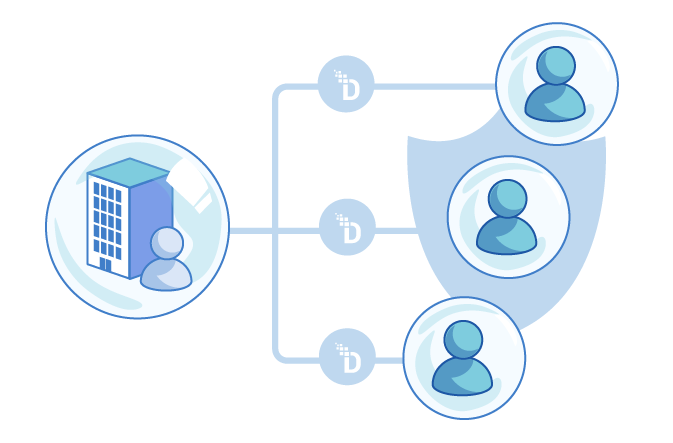
Attribute-based access control (ABAC) is an authorization model that evaluates attributes (e.g., properties of the user, the resource, the action, and the environment) against a set of policies at the time of each access request.
Unlike role-based access control (RBAC), which assigns permissions based on static roles, ABAC makes dynamic, context-aware decisions.
The National Institute of Standards and Technology (NIST) formalized the model in SP 800-162.
ABAC is the most flexible access control methodology in use today and underpins zero-trust architectures, regulatory compliance frameworks, and fine-grained data security strategies across enterprise environments.
Attribute-based access control evaluates four categories of attributes every time a user or system requests access to a resource:
A policy engine evaluates these attributes in real time against a defined rule set. If the attributes satisfy the policy conditions, access is granted. If they do not, the request is denied or escalated.
For example, a policy might state: "Allow a physician to view patient records if the physician's department matches the patient's department, the request occurs during business hours, and the physician is accessing the system from a hospital-approved device." That single policy replaces dozens of static role assignments.
NIST SP 800-162 defines four functional components that make up the ABAC decision architecture:
This architecture decouples policy from enforcement. You write policies once in the PAP, the PDP evaluates them, the PEP enforces them, and the PIP feeds live attribute data into the decision.
The result is an attribute-based access control system that adapts to new users, resources, and conditions without manual permission updates.
XACML (eXtensible Access Control Markup Language) is the OASIS (Organization for the Advancement of Structured Information Standards) standard commonly used to express ABAC policies in a machine-readable format.
Cloud providers such as Amazon Web Services (AWS) and Azure have also implemented native ABAC capabilities in their identity and access management (IAM) services.
Static access control models break down in complex, distributed environments. RBAC (the most widely deployed model) assigns permissions to roles, and roles to users.
This works well in smaller organizations with stable hierarchies. It does not scale when the number of unique access requirements outgrows the number of manageable roles.
This problem is known as role explosion. A bank with 40,000 employees, spanning multiple geographies and dozens of applications can accumulate thousands of roles, each representing a narrow set of permissions. Managing, auditing, and maintaining those roles becomes an operational burden, weakening security and increasing data breach risk.
Attribute-based access control eliminates role explosion by shifting access decisions from static assignments to dynamic evaluations.
A single ABAC policy can replace hundreds of individual roles because it evaluates conditions at the time of each request. You do not need a separate role for "Analyst – New York – Morning Shift – Read Only." You write a policy that evaluates the analyst's location, shift schedule, and requested action.
Regulatory frameworks reinforce this shift. HIPAA's minimum necessary standard requires organizations to limit access to the minimum information needed for a given purpose. GDPR's purpose limitation principle demands that data processing be restricted to its stated purpose.
PCI DSS requires granular access controls around cardholder data. Attribute-based access control satisfies these requirements at a granular level that RBAC alone cannot achieve.
Zero-trust architectures depend on attribute-based access control. The core principle of zero trust – i.e., never trust, always verify – requires continuous, context-aware evaluation of every access request.
Attribute-based access control provides that evaluation by incorporating user identity, device posture, network context, and resource sensitivity into every decision.
RBAC and ABAC are not mutually exclusive. They are complementary models that operate at different levels of granularity. Understanding their differences clarifies when each model is appropriate and why many enterprises deploy both.
RBAC answers the question: "Does this user have the right role?" ABAC answers a more complete question: "Does this user, with these attributes, requesting this action, on this resource, under these conditions, satisfy the policy?"
What most enterprise security teams miss is that ABAC is not a replacement for RBAC. It is an extension.
The most effective implementations use RBAC as a baseline – i.e., controlling which applications or systems a user can access – and layer ABAC on top for fine-grained, data-level decisions.
This is especially relevant in data access control. A user may have role-based access to a CRM application. ABAC determines whether that user sees the full Social Security number, the last four digits, or a masked value, all based on their department, location, and the sensitivity classification of the record.
Attribute-based access control is one of several access control methodologies. Each model reflects a different trade-off between simplicity and precision.
Attribute-based access control subsumes RBAC – i.e., every RBAC policy can be expressed as an attribute-based access control policy (where the only evaluated attribute is the user's role), but ABAC policies cannot always be reduced to RBAC.
This is why NIST and industry analysts position attribute-based access control as the more mature model for enterprise access control.
Attribute-based access control is deployed across industries wherever access decisions require more context than a user's role alone can provide.
A hospital implements attribute-based access control to ensure physicians view patient records only within their assigned department and during scheduled shifts.
Nurses in the emergency department see different fields than billing administrators, not because of separate roles, but because ABAC evaluates department, function, and record sensitivity simultaneously. This directly supports HIPAA's minimum necessary requirement.
A trading firm uses attribute-based access control to manage access to market data based on a trader's jurisdiction, certification level, and the data's regulatory classification.
A trader licensed in the EU can access European market instruments but cannot view U.S.-regulated datasets unless their attributes satisfy the corresponding policy.
Attribute-based access control originated in environments that required clearance-level access decisions.
A user's clearance, citizenship, program affiliation, and need-to-know status are evaluated as attributes against the resource's classification. NIST SP 800-162 was written specifically to guide federal agencies through this implementation.
AWS IAM supports ABAC through resource tags, allowing policies that grant access only when a user's attributes match the tags on a resource.
Azure's attribute-based access control evaluates conditions within role assignments. Both approaches reduce the number of individual policies required to manage access at scale.
At the data layer, attribute-based access control determines how sensitive fields are handled, i.e., whether a user sees the actual value, a tokenized substitute, or a de-identified representation. This field-level enforcement goes beyond application access. It controls what data a user sees within an application, based on attributes evaluated in real time.
Eliminates role explosion. A single ABAC policy can express access logic that would require hundreds of static roles. This reduces administrative overhead and simplifies audits.
Supports zero trust and least privilege. ABAC evaluates every access request individually, incorporating context that static models ignore. This aligns with the zero-trust principle of continuous verification.
Adapts without policy rewrites. When a new department, location, or data classification is introduced, existing ABAC policies adapt automatically — as long as the attributes are present. You do not need to create new roles or update individual permission assignments.
Enables regulatory compliance. ABAC's granularity maps directly to regulatory requirements. HIPAA's minimum necessary, GDPR's purpose limitation, and PCI DSS's need-to-know principles are all expressions of attribute-based logic.
Scales across hybrid environments. ABAC policies can be enforced consistently across on-premises, cloud, and SaaS environments when backed by a centralized policy engine and a shared attribute source.
Policy authoring complexity. Writing effective ABAC policies requires a clear attribute taxonomy — a structured definition of every subject, resource, action, and environment attribute in your organization. Without this foundation, policies become inconsistent and difficult to maintain.
Auditing difficulty. RBAC makes it easy to answer "who can access what" – i.e., you inspect the role. ABAC makes this harder because access depends on runtime conditions. Simulation and testing tools are necessary to trace how policies resolve under different attribute combinations.
Performance considerations. Real-time attribute evaluation adds latency to every access request. In high-throughput environments, the policy engine must be optimized and cached to avoid degrading user experience.
Attribute source integration. ABAC depends on accurate, real-time attribute data from identity providers, directories, HR systems, and device management platforms. If attribute sources are stale or inconsistent, access decisions become unreliable.
Define subject, resource, action, and environment attributes before writing a single policy. Document each attribute's source, format, update frequency, and ownership.
This taxonomy is the foundation of every access decision, and it often begins with data discovery to understand what sensitive data exists across your environment.
Start with broad role-based controls for application access. Apply ABAC for fine-grained decisions within applications, i.e., field-level visibility, data-level masking, and context-dependent authorization.
Avoid embedding access logic inside individual applications. Use a centralized policy engine (PDP) that all enforcement points reference. This ensures consistency, simplifies auditing, and enables policy changes without application redeployment.
Test ABAC policies against real access patterns in a non-production environment before enabling enforcement. Simulation reveals unintended denials, over-permissive combinations, and missing attribute coverage.
IAM-layer ABAC controls who can access a system. Data-layer ABAC controls what a user sees within that system. Both layers are necessary for defense in depth.
Data security platforms that enforce field-level tokenization and dynamic data masking based on user attributes implement this second layer.
Log every policy decision – i.e., the attributes evaluated, the policy applied, and the outcome. Feed these logs into your security monitoring pipeline. Continuous audit trails are essential for regulatory compliance and incident investigation.
Attributes change. Employees move departments. Clearance levels expire. Device posture degrades. Build processes to update, validate, and retire attributes on a defined cadence. Stale attributes lead to incorrect access decisions.
Attribute-based access control is typically discussed in the context of identity and access management – i.e., controlling who can access which systems.
The next frontier is applying attribute-based access control at the data layer, where the decision is not just "can this user access the application?" but "what specific data values should this user see?"
Data security platforms that enforce attribute-based policies at the field level extend ABAC from the perimeter to the payload.
DataStealth applies this model through dynamic data masking and tokenization, evaluating user attributes (e.g., role, department, location, device posture) to determine field-level visibility in real time, without code changes or application modifications.
See how DataStealth enforces attribute-based data protection across your environment →